

Laparoscopic surgery, often called keyhole or minimally invasive surgery, allows surgeons to perform major operations inside the abdomen through a few small incisions instead of one long cut. Today it is the standard approach for most common abdominal operations.
The difference you can see
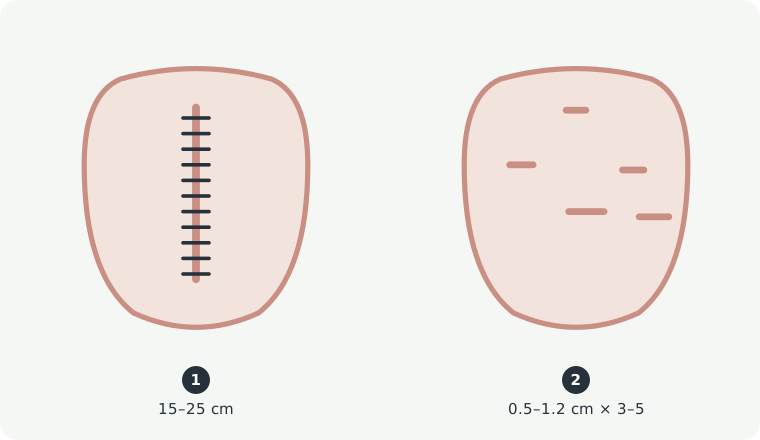
- Open surgery: one incision of about 15–25 cm, through which the surgeon works directly with the hands.
- Laparoscopic surgery: usually 3–5 incisions of 0.5–1.2 cm each.
How does laparoscopic surgery work?
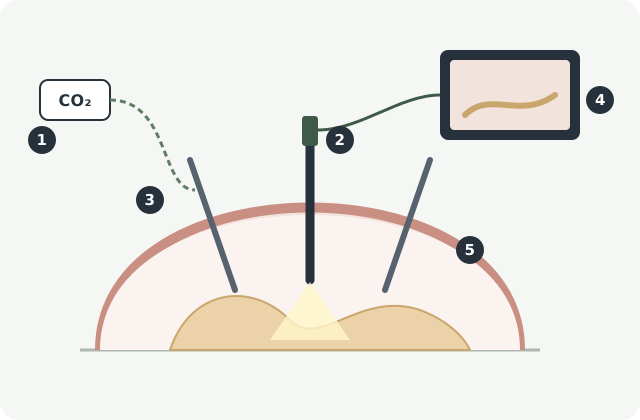
- Carbon dioxide gas gently inflates the abdomen.
- The camera (laparoscope) with a light source is passed through one small incision.
- Long, thin instruments pass through the other incisions via small tubes called trocars.
- A high-definition monitor shows the inside of the abdomen, magnified several times.
- The working space created by the gas lets the surgeon see and work safely.
At the end of the operation the gas is released and the small incisions are closed, usually with dissolvable stitches or skin glue.
Benefits compared with open surgery
| Laparoscopic surgery | Open surgery | |
|---|---|---|
| Incisions | 3–5 small incisions (0.5–1.2 cm) | One incision (15–25 cm) |
| Pain after surgery | Less; usually controlled with simple painkillers | More; often needs stronger painkillers |
| Hospital stay* | Same day to 2 nights | 3–7 days |
| Return to desk work* | About 1 week | 4–6 weeks |
| Wound infection | Less common | More common |
| Incisional hernia later | Rare | More common |
| Scars | Small, fade well | One long scar |
| Surgeon's view | Magnified, high definition | Direct, unmagnified |
*Typical figures for common operations such as gallbladder removal; they vary with the operation and your health.
There is also less handling of the bowel, so it often recovers faster, and earlier walking lowers the risk of chest infection and blood clots.
Which operations can be done laparoscopically?
- Gallbladder removal for gallstones
- Appendix removal (appendicitis)
- Hernia repair: inguinal, umbilical, and incisional
- Hiatus hernia and reflux surgery
- Weight-loss surgery: sleeve gastrectomy, mini gastric bypass, classic gastric bypass
- Selected bowel surgery
- Diagnostic laparoscopy, to find the cause of abdominal pain when scans are not conclusive
When is open surgery still the right choice?
Laparoscopy is not suitable for everyone or every situation. Open surgery may be safer:
- in some emergencies where the patient is unstable
- when there are extensive adhesions from previous operations
- for some very large tumours
- when heart or lung disease means the patient cannot tolerate the gas in the abdomen
Sometimes an operation that starts laparoscopically is converted to open surgery during the procedure. This is a decision made for your safety, not a failure, and we discuss the possibility with you before surgery.
Recovery after laparoscopic surgery
- Walking: start on the day of surgery; it speeds recovery and prevents clots.
- Shoulder pain: common for 1–3 days, caused by the gas irritating the diaphragm. Walking helps.
- Wounds: you can usually shower after 24–48 hours. Bruising around the small incisions is normal.
- Activity: light activity within days; avoid heavy lifting for about 4–6 weeks, depending on the operation (longer after hernia repair).
- Call us urgently if you have fever, increasing abdominal pain, a fast heart rate, shortness of breath, vomiting that doesn't stop, or redness and pus from a wound.
Is laparoscopic surgery right for you?
Most patients who need abdominal surgery today can have it laparoscopically. We review your history, previous operations and scans to choose the safest approach for you.
Book a consultation or message us on WhatsApp.
This article is for patient education and does not replace a medical consultation.